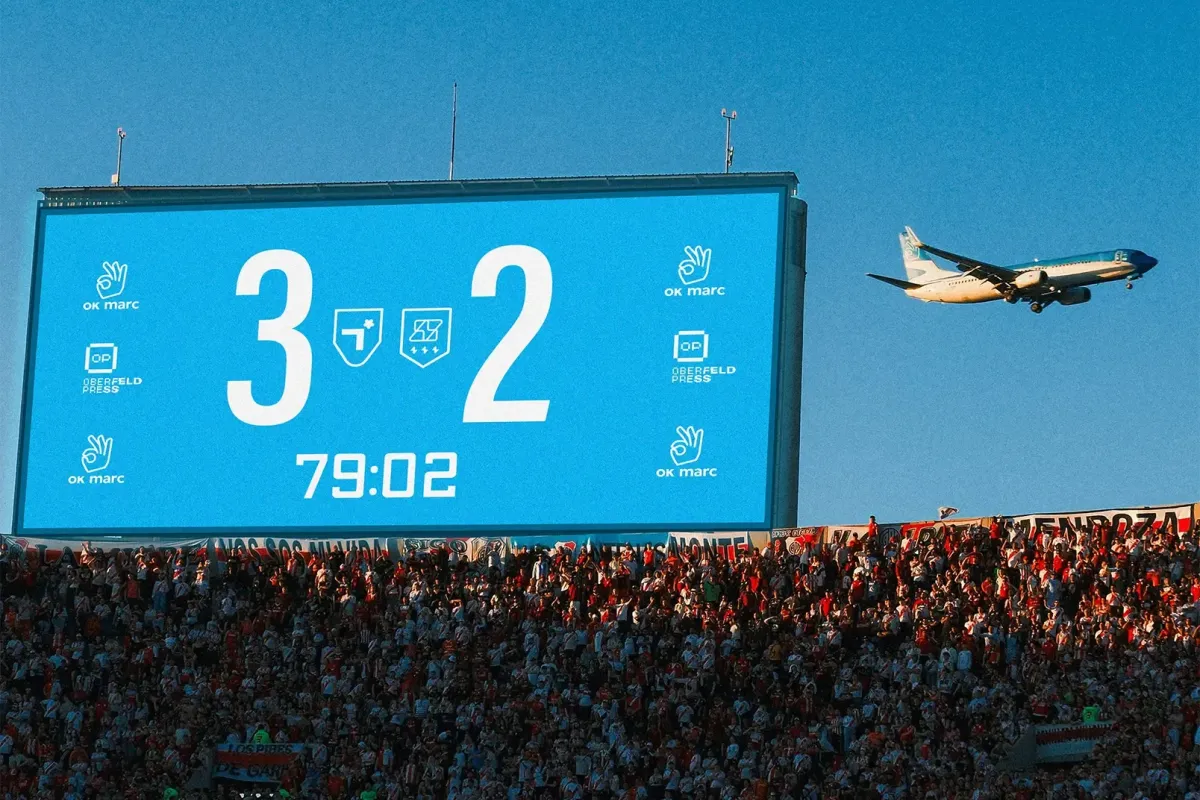

We have become extraordinarily good at optimizing what we can measure. That does not mean we are building stronger businesses.
For most of the past two decades, optimization has been treated as something close to an unquestioned business virtue.
Make the process faster. Reduce friction. Automate the repetitive parts. Shorten the sales cycle. Lower acquisition costs. Improve conversion rates. Eliminate waste. Count the click. Track the likes. Increase output. Find the measurable variable, improve it, and repeat.
There is nothing inherently wrong with any of that. Better-performing systems are generally preferable to worse-performing ones.
The problem begins when efficiency stops being a means of improving a business and becomes the definition of a good business. When the measure becomes the goal.
That distinction matters because a system can become increasingly efficient while simultaneously becoming more fragile. It can become very good at producing an immediate result while losing the qualities that allow it to adapt, differentiate, earn trust, or withstand changes in the environment around it.
Manufacturing has already begun confronting this tension.
The industrial transformation commonly described as Industry 4.0 brought extraordinary advances in automation, connectivity, data, robotics, and machine intelligence. Its underlying promise was straightforward: smarter, more connected production systems could operate with greater precision, efficiency, and productivity.
The emerging conversation around Industry 5.0 does not reject those advances. Instead, it asks a more mature question about what happens after optimization. The European Commission, which has done the most to shape the idea, builds it around three priorities: resilience, human-centricity, and sustainability. Those priorities translate into hard questions.
How do we build systems that are not merely productive, but resilient? How do technology and automation strengthen human capability rather than simply remove human involvement? How do organizations account for sustainability and long-term wellbeing alongside immediate output?
The specifics belong to industrial policy and manufacturing. But the underlying correction should sound familiar far beyond the factory floor.
We have optimized one dimension of performance so aggressively that we are being forced to rediscover the system around it.
Marketing has been running the same experiment
The modern marketing organization has undergone its own version of this transformation.
Digital platforms gave businesses unprecedented visibility into customer behavior. Media became measurable. Attribution became more sophisticated. Campaigns could be adjusted in real time. Marketing teams could see impressions, clicks, engagement, acquisition costs, conversions, and revenue with a degree of precision previous generations could barely imagine.
Again, this was progress.
But measurement has a habit of becoming management. It is a version of the problem economists know as Goodhart’s Law: once a measure becomes a target, the system begins adapting to the measure rather than the outcome it was meant to represent.
Once an organization can see a number clearly, improving that number becomes extremely compelling. Budgets move toward the channels that produce the most immediate attributable results. Teams invest in the tactics that can demonstrate performance. Activities that are harder to measure are placed under increasing pressure to justify themselves in the language of short-term return.
Eventually, the organization can become extremely sophisticated at answering one question:
What worked?
And surprisingly weak at answering another:
What are we building?
Those are not the same question.
A campaign can work without strengthening the brand. A conversion funnel can improve while the organization becomes less differentiated. Customer acquisition can become more efficient while the business grows increasingly dependent on the platform delivering those customers. Revenue can rise while pricing power, strategic clarity, and customer preference quietly erode underneath it.
The dashboard may look healthier while the system becomes more vulnerable.
Optimization creates dependencies
This is one of the central tensions I explore in The Brand Operating System.
Businesses frequently respond to growth pressure by increasing tactical activity. More media. More content. More campaigns. More channels. More technology. More measurement.
At first, this can work extraordinarily well. But success encourages greater dependence on the mechanisms producing it.
A company becomes dependent on paid media to sustain demand. Teams become dependent on platforms they do not control. Growth expectations require a constant stream of campaigns. Positioning gradually bends toward whatever generates the strongest immediate response. Competitors adopt the same tools, channels, language, and best practices.
What began as optimization eventually produces a predictable cascade:
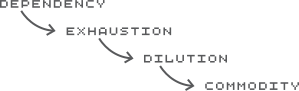
None of those problems occur because the organization stopped optimizing. They occur because it never stopped.
The mistake is not the pursuit of efficiency. The mistake is assuming efficiency and strength are synonymous.
Resilience asks a different question
Optimization asks how effectively a system performs under the conditions for which it was designed. Resilience asks what happens when those conditions change.
- What happens when customer acquisition costs rise?
- What happens when an algorithm changes?
- What happens when the category becomes crowded with competitors making essentially identical claims?
- What happens when economic conditions suddenly change what customers value?
- What happens when the organization doubles in size and the founder can no longer personally maintain the clarity that once held everything together?
Strong businesses need to perform well under favorable conditions. They also need enough internal coherence to remain recognizable and strategically useful when those conditions move.
That is one of the reasons I think we need to understand brand differently. Brand is usually discussed as an instrument of communication: identity, messaging, awareness, reputation, campaigns. Those things matter. But they are outputs of something deeper.
A functioning brand system creates shared understanding about what the organization stands for, who it serves, how it creates value, what makes it meaningfully different, and how those ideas should influence decisions across the business.
When that infrastructure is strong, the company is less dependent on any individual marketing tactic continuing to perform exactly as expected. It has somewhere to stand when the environment changes.
That is positioning resilience.
The strongest systems do not optimize a single variable
This is where the comparison to Industry 5.0 becomes useful. Its significance is not that manufacturing discovered three new boxes to check after completing Industry 4.0. The more interesting shift is the recognition that productivity cannot be evaluated independently from the larger system producing it. Efficiency matters. So do resilience, human capability, and sustainability, and these outcomes interact. Improving one while degrading the others may produce impressive short-term numbers without producing a stronger enterprise.
Brand operates in much the same way. Awareness cannot be separated indefinitely from meaning, and customer acquisition cannot be separated from preference. Consistency depends on organizational understanding. Reputation depends on operational behavior. Differentiation is only as credible as the capabilities behind it. When these conditions reinforce one another, trust compounds. When they drift apart, tactical activity has to work increasingly hard to compensate.
The most important business systems are rarely built by maximizing a single variable. They are built by managing the relationships between variables.

When almost anyone can generate almost anything, clarity becomes more valuable..
AI will make this problem more visible, not less
We are about to become dramatically more efficient at producing many of the things organizations previously found difficult or expensive to create.
Artificial intelligence can already accelerate research, analysis, writing, design, personalization, production, customer service, software development, and countless other forms of knowledge work. The capabilities will continue improving, and organizations would be foolish to ignore the productivity gains available to them.
But the same pattern is likely to repeat.
As production becomes easier, organizations will produce more.
As tools become widely available, competitors will gain access to similar capabilities.
As execution becomes cheaper, execution itself becomes less distinctive.
The limiting resource moves elsewhere. It stops being the ability to produce another hundred ideas and becomes the judgment to know which one deserves to exist. It stops being how many messages you can generate and becomes knowing what the organization should say. The goal isn’t to remove humans from the system. It’s to design systems where human judgment can operate at a higher level.
AI may turn out to be one of the strongest arguments yet for treating brand as infrastructure. When almost anyone can generate almost anything, clarity becomes more valuable.
Beyond optimization
It would be easy to treat Industry 5.0 as the next framework: another diagram, another vocabulary for businesses to adopt. I’m less interested in the framework than in the pattern behind it. A discipline spends years getting extraordinarily good at optimization, and eventually the limits show. The conversation moves up a level, from improving individual outputs to asking whether the system producing them is healthy. Manufacturing is having that conversation now. Marketing needs to have it too.
The answer is not less technology, less measurement, or less performance discipline. It is a broader definition of performance. Businesses should absolutely know whether their marketing works. They should also know whether the system underneath it is getting stronger, because efficiency tells you how well the machine is running. It doesn’t tell you whether you built the right machine.
Further Reading
Breque, Maija, Lars De Nul, and Athanasios Petridis. Industry 5.0: Towards a Sustainable, Human-Centric and Resilient European Industry. European Commission, 2021.
European Commission report
Binet, Les, and Peter Field. The Long and the Short of It: Balancing Short and Long-Term Marketing Strategies. Institute of Practitioners in Advertising, 2013.
Institute of Practitioners in Advertising
Binet, Les, and Will Davis. Go Big or Go Home. Institute of Practitioners in Advertising, 2026.
Institute of Practitioners in Advertising
Hagiu, Andrei, and Julian Wright. “Don’t Let Platforms Commoditize Your Business.” Harvard Business Review, May–June 2021.
Harvard Business Review
Brynjolfsson, Erik, Danielle Li, and Lindsey R. Raymond. “Generative AI at Work.” The Quarterly Journal of Economics, vol. 140, no. 2, 2025, pp. 889–942.
The Quarterly Journal of Economics
Dell’Acqua, Fabrizio, et al. “Navigating the Jagged Technological Frontier: Field Experimental Evidence of the Effects of Artificial Intelligence on Knowledge Worker Productivity and Quality.” Organization Science, vol. 37, no. 2, 2026, pp. 403–423.
Organization Science
Stress, Marc V. The Brand Operating System: The Architecture of Trust, Authority, and Growth. Oberfeld Press, 2026.
Book information · Amazon (affiliate link)
This argument is the subject of The Brand Operating System. The book is written for people responsible for managing, evolving, and growing brands. It’s about the system underneath the measurement, not the dashboard on top of it.
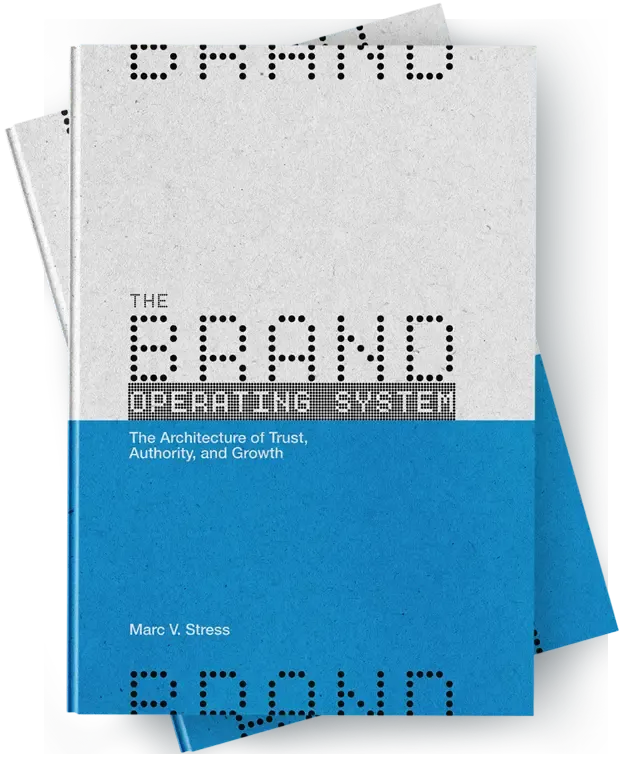
The Brand Operating System
Brand compounds when it's a system. Depreciates when it's a campaign.
Post Main Image: Quin Stephenson, Unsplash
Dependency Cascade: Illustration from Brand Operating System, Marc Stress
Post Image inline: Julian Tell, Death to Stock